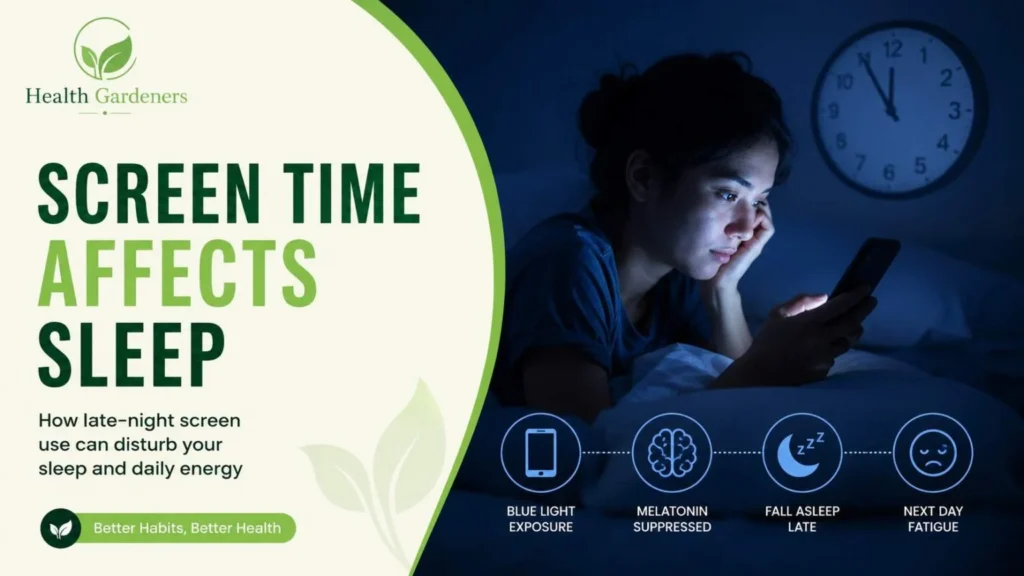
Screen time affects sleep in three ways: the light from screens can delay your body’s sleep signals, engaging content keeps your mind alert, and time spent scrolling pushes your bedtime later. In one sleep-lab study, people who read on a tablet before bed took about 10 minutes longer to fall asleep and felt sleepier the next morning than when they read a printed book. Health bodies advise switching off devices at least 30 minutes before bedtime. This guide covers what the research shows, whether night mode and blue light glasses help, and practical steps to take.
Key Takeaways
- Screens can affect sleep through light, mental stimulation, and lost sleep time.
- In a lab study, evening tablet reading delayed the body’s melatonin rise by more than 1.5 hours.
- A study of night mode on phones found it did not improve sleep.
- A review of 17 trials found blue light glasses probably make no difference to sleep quality.
- The most reliable fix is the simplest: stop using screens 30 to 60 minutes before bed.
How Common Is Screen Use Before Bed?
Very common. A survey of 1,508 American adults, cited in a study published in the Proceedings of the National Academy of Sciences, found that 90% used some type of electronic device within an hour of bedtime at least a few nights a week.
3 Ways Screen Time Affects Sleep
1. Light Delays Your Body’s Sleep Signals
Your body clock uses light to tell day from night. In the evening, your body releases melatonin, a hormone that helps you feel sleepy. Light in the evening can hold that release back.
The study mentioned above tested this directly. Twelve healthy young adults stayed in a sleep laboratory for 14 days. For five evenings they read on a tablet for about 4 hours before bed, and for another five evenings they read a printed book. Compared with the printed book, tablet reading:
- lengthened the time to fall asleep by nearly 10 minutes
- reduced evening melatonin levels by about 55%
- delayed the body’s melatonin rise by more than 1.5 hours the following day
- reduced REM sleep by about 12 minutes
- left people feeling sleepier the next morning, and it took them longer to feel fully alert
Total sleep time was the same in both conditions because bedtime and wake time were fixed. The researchers pointed out that at home, where people choose their own bedtime, the effect could be larger.
The study had limits. It was small, the tablet was set to maximum brightness, the room was very dim, and the reading sessions lasted 4 hours, which is longer than many people use a device before bed.
2. Content Keeps Your Mind Alert
What you do on the screen matters as well as the light. Messages, news, videos, and games are designed to hold your attention, which works against winding down.
The National Sleep Foundation asked a panel of 16 experts to review 574 published studies. The panel agreed that, in general, screen use impairs sleep health in children and adolescents, and that the content of screen use before bed has a negative effect on their sleep. Stimulating content at night was singled out as a particular problem. The panel’s agreed conclusions covered children and teenagers, and the tablet study described above suggests adults are affected too.
3. Screens Push Your Bedtime Later
The tablet study found that people felt less sleepy in the evening while using a light-emitting device. The researchers noted that this increased alertness may lead users to delay bedtime at home. One more episode or a few more minutes of scrolling can easily cost half an hour of sleep, and that adds up across a week. Our article on sleep debt explains why that matters.
Does Night Mode Help You Sleep?
Most phones now have a night mode that shifts the screen to warmer colours in the evening. A study from Brigham Young University tested whether this improves sleep. Researchers assigned 167 adults aged 18 to 24 to one of three groups for the hour before bed: phone use with Night Shift on, phone use with Night Shift off, or no phone use.
Across the whole group, there were no differences in sleep between the three conditions. Among participants who averaged about seven hours of sleep, those who did not use a phone before bed had better sleep quality than both phone groups, whether Night Shift was on or off.
The researchers concluded that blue light is unlikely to be the only factor, and that the mental engagement of texting, scrolling, and posting also affects sleep. Night mode may be easier on your eyes, but it is not a substitute for putting the phone down.
Do Blue Light Glasses Work?
Probably not for sleep. A Cochrane review of 17 randomised controlled trials, summarised by City St George’s, University of London, found that blue-light filtering glasses probably make no difference to sleep quality or to eye strain from computer use. The trials were small and short, so the reviewers called the evidence inconclusive and said better studies are needed.
The review authors added two useful facts. These lenses typically filter out only about 10 to 25% of blue light. And the amount of blue light your eyes receive from screens is about a thousandth of what they get from natural daylight.
What Helps and What Does Not
| Approach | What the evidence shows |
|---|---|
| No screens for 30 to 60 minutes before bed | Recommended by the CDC, NIH, and American Academy of Sleep Medicine. In the BYU study, no phone use gave the best sleep quality among people sleeping about 7 hours. |
| Reading a printed book instead | Led to faster sleep onset and better morning alertness than tablet reading in a lab study. |
| Night mode or warm screen settings | No improvement in sleep in the BYU study. |
| Blue light glasses | Probably no difference to sleep quality, based on 17 trials. |
| Avoiding stimulating content at night | Advised by the National Sleep Foundation for children and teenagers. |
How Long Before Bed Should You Stop Using Screens?
Official guidance ranges from 30 minutes to an hour:
- The CDC and the American Academy of Sleep Medicine advise turning off electronic devices at least 30 minutes before bedtime.
- The National Heart, Lung, and Blood Institute recommends using the hour before bed for quiet time and avoiding bright artificial light, such as from a TV or computer screen.
Thirty minutes is a sensible minimum. An hour is better if you can manage it.
8 Ways to Reduce Screen Time Before Bed
- Set a screen cut-off alarm. Have your phone remind you 30 to 60 minutes before bedtime.
- Charge your phone outside the bedroom. If that is not possible, put it across the room, out of reach from the bed.
- Use a separate alarm clock so you have no reason to keep the phone by your pillow.
- Turn on Do Not Disturb or a sleep schedule so notifications stop in the evening.
- Replace scrolling with something specific. Keep a printed book, a notebook, or a puzzle by your bed.
- Lower screen brightness in the evening if you must use a device, and keep the content calm.
- Keep the TV out of the bedroom, or use a sleep timer so it does not run all night.
- Finish the hard stuff early. Reply to work emails and stressful messages before your wind-down hour starts.
For a full evening plan, follow our night routine for better sleep.
Screens and Children’s Sleep
The National Sleep Foundation recommends these steps for families:
- Talk with children about how screens can affect sleep.
- Set time limits on screen use, especially at night.
- Supervise night-time content and avoid stimulating or upsetting material.
- Keep an early, regular, relaxing bedtime routine without screens.
- Set an example with your own night-time screen use.
When Screens Are Not the Problem
Cutting screen time helps many people, but it will not fix every sleep problem. If you have removed screens from your evening and still struggle to sleep, or you are tired even after enough sleep, other causes may be involved. Our guide on how to improve sleep quality naturally covers the other main habits. See a doctor if sleep problems continue for more than a few weeks.
Frequently Asked Questions
Does screen time affect sleep?
Yes. Evening screen use can delay the body’s sleep signals, keep the mind alert, and push bedtime later. In a lab study, tablet reading before bed added nearly 10 minutes to the time it took to fall asleep.
Does blue light really affect sleep?
Evening light from screens can suppress melatonin and delay the body clock, as shown in laboratory research. Studies of night mode and blue light glasses suggest light is only part of the story, and that what you do on the screen matters too.
Does night mode help you sleep?
A Brigham Young University study of 167 young adults found no difference in sleep between using a phone with Night Shift on, with it off, or not using a phone at all. Among people who slept about seven hours, not using a phone gave the best sleep quality.
Do blue light glasses improve sleep?
A Cochrane review of 17 trials found they probably make no difference to sleep quality, although the evidence was limited and uncertain.
Is watching TV before bed bad for sleep?
A TV is a bright screen with engaging content, so the same advice applies. The NIH recommends avoiding bright artificial light from a TV or computer screen in the hour before bed.
Is it better to read a book or a tablet before bed?
A printed book. In a lab study, people fell asleep faster and felt more alert the next morning after reading a printed book than after reading on a tablet.
How long before bed should I stop using my phone?
At least 30 minutes, according to the CDC and the American Academy of Sleep Medicine. The NIH suggests keeping the full hour before bed as quiet time.
The Bottom Line
Screen time affects sleep through light, stimulation, and lost time. Night mode and blue light glasses have not been shown to solve the problem. What works is putting screens away 30 to 60 minutes before bed and filling that time with something calm, such as reading a printed book.
Sources
- Chang AM, et al. Evening use of light-emitting eReaders negatively affects sleep, circadian timing, and next-morning alertness. Proceedings of the National Academy of Sciences.
- National Sleep Foundation. Effects of Screen Use on Children’s Sleep.
- Brigham Young University. Is Night Shift really helping you sleep better?
- City St George’s, University of London. Blue-light filtering spectacles probably make no difference to eye strain, visual performance or sleep quality.
- Centers for Disease Control and Prevention. About Sleep.
- American Academy of Sleep Medicine. Healthy Sleep Habits.
- National Heart, Lung, and Blood Institute. Healthy Sleep Habits.
This article is for general information only and is not medical advice. Read our full Disclaimer.

The Health Gardeners Team researches and writes practical wellness content on sleep, nutrition, energy, and daily habits. Our articles are based on published research and guidance from reputable health organizations, and we review and update them regularly. We are not medical professionals, and our content is for general information only. It is not a substitute for advice from a qualified healthcare provider. Learn more about us.