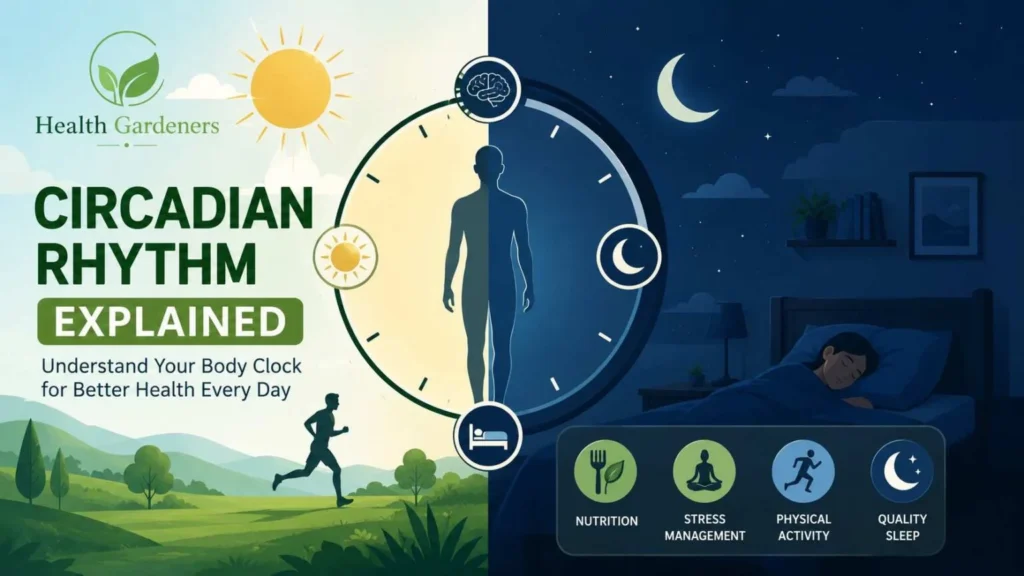
Circadian rhythm is your body’s internal 24-hour clock. It controls when you feel sleepy and when you feel alert, and it also influences hormone release, appetite, digestion, and body temperature. Light and darkness are its strongest signals. When your daily schedule matches your body clock, sleep comes more easily and energy is steadier. When the two fall out of sync, you can feel drowsy, unfocused, and tired even after enough hours in bed. This guide explains how the body clock works, what disrupts it, and how to keep it on track.
Key Takeaways
- Circadian rhythms are physical, mental, and behavioural changes that follow a 24-hour cycle.
- A master clock in the brain coordinates clocks in nearly every tissue and organ.
- Light is the strongest signal. Food, stress, physical activity, and temperature also play a part.
- Jet lag, shift work, and light from screens at night can push the body clock out of sync.
- Teenagers naturally run later, and older adults tend to wake earlier.
What Is Circadian Rhythm?
The National Institute of General Medical Sciences (NIGMS), part of the US National Institutes of Health, describes circadian rhythms as some of the physical, mental, and behavioural changes an organism experiences over a 24-hour cycle. Most living things have them, including animals, plants, and microorganisms.
In humans, nearly every tissue and organ has its own circadian rhythm. Together they are tuned to the daily cycle of day and night. According to NIGMS, circadian rhythms influence:
- sleep patterns
- hormone release
- appetite and digestion
- body temperature
The terms “body clock” and “biological clock” are often used for the same idea. Strictly speaking, the biological clock is the system that keeps time, and the circadian rhythm is the daily pattern it produces.
How Your Body Clock Works
The Master Clock in Your Brain
Your body has many clocks, and one master clock keeps them coordinated. NIGMS explains that the human master clock is a large group of nerve cells in the brain called the suprachiasmatic nucleus, or SCN. It synchronises the rhythms in organs and tissues across the body.
Each clock is built from proteins, and the genes that make them switch on and off in a set order. In 2017, three researchers won the Nobel Prize for discovering how one of these proteins rises and falls over 24 hours in fruit flies, in a loop that repeats every day.
Light, Melatonin, and Cortisol
Light is how the master clock knows what time it is. The National Heart, Lung, and Blood Institute (NHLBI) explains the process this way:
- Light signals received through your eyes tell your brain that it is daytime.
- In the evening, the level of melatonin in your bloodstream starts to rise. Melatonin is a hormone thought to promote sleep, and it peaks in the early morning.
- As you are exposed to more light, such as at sunrise, your body releases cortisol, a hormone that prepares your body to wake up.
Bright artificial light in the late evening can interfere with this process and prevent your brain from releasing melatonin, which makes it harder to fall asleep.
Sleep Pressure: The Second System
Your body clock is not the only thing that makes you sleepy. NHLBI describes a second process: your need for sleep builds the longer you stay awake. A compound called adenosine is linked to this. Its level in your brain rises while you are awake, and the rising level signals a shift toward sleep. Caffeine works by blocking adenosine.
You sleep best when both systems line up, meaning sleep pressure is high at the same time your body clock is signalling night.
How Circadian Rhythm Affects Your Daily Energy
Energy is not flat across the day. It rises and falls in a pattern set largely by your body clock. NIGMS illustrates this with the cycle of a typical teenager:
| Time of day | What happens |
|---|---|
| 10 a.m. to 1 p.m. | Energy up |
| 2 p.m. to 5 p.m. | Afternoon slump |
| Around 11 p.m. | Getting sleepy |
| 3 a.m. to 7 a.m. | The big dip, when alertness is lowest |
These times describe a typical teenager. Adults often run somewhat earlier, and individuals differ. The shape of the pattern is the useful part: a rise in the late morning, a dip in the afternoon, and the lowest point in the early hours of the morning.
This explains two common experiences. An afternoon slump is a normal part of the daily rhythm, although a heavy lunch can make it feel worse. And sleeping at the wrong time for your body clock can leave you tired even when you get enough hours. Read more in our guide on why you feel tired after sleeping enough.
Are You a Morning Person or a Night Owl?
According to NHLBI, most people’s natural circadian cycle is slightly longer than 24 hours, and some people naturally wake early while others naturally stay up late. This is a real biological difference. It does not mean a night owl lacks discipline. Problems arise when your natural timing clashes with work, school, or family schedules.
How Circadian Rhythm Changes With Age
- Teenagers. NHLBI notes it is natural for many teens to prefer later bedtimes and to sleep later in the morning than adults.
- Older adults. The rhythm and timing of the body clocks decline with age. Brain cells that promote sleep are lost as part of normal ageing, which makes it harder to stay asleep. Less physical activity and less time outdoors also affect circadian rhythms. As a result, older adults usually sleep less and wake up earlier.
What Disrupts Your Circadian Rhythm?
NIGMS lists several ways the body clock can fall out of sync with the outside world:
- Light from electronic devices at night, which can confuse biological clocks. See our article on how screen time affects sleep.
- Travel between time zones, which causes jet lag.
- Shift work, which alters the normal sleep-wake cycle.
- Genes. Variants of certain genes can affect the proteins that control biological clocks.
- Some neurological conditions, such as Alzheimer’s disease.
NHLBI adds that caffeine and artificial light can give your body false wakefulness cues.
Social Jet Lag
You do not need to board a plane to get jet lag. NHLBI’s page on types of circadian rhythm disorders describes social jet lag, which can occur when your activities on weekends or days off happen at much later times than on workdays. It is not considered a disorder, but staying up late on Friday and Saturday and then waking early on Monday puts your body through a similar shift.
What Happens When Your Body Clock Is Out of Sync?
In the short term, NIGMS states that drowsiness, poor coordination, and difficulty with learning and focus may occur.
Over the long term, sleep loss and continually shifting circadian rhythms can increase the risk of obesity, diabetes, mood disorders, heart and blood pressure problems, and cancer, and can worsen existing health issues.
Circadian Rhythm Disorders
When the mismatch is persistent and affects daily life, it may be a circadian rhythm disorder. NHLBI describes six types:
| Type | What it looks like |
|---|---|
| Delayed sleep-wake phase disorder | Falling asleep later than you want and struggling to wake on time. One of the most common types. |
| Advanced sleep-wake phase disorder | Finding it very hard to stay awake in the early evening and waking too early. |
| Irregular sleep-wake rhythm disorder | Several short periods of sleep and wakefulness across the day and night. |
| Non-24-hour sleep-wake rhythm disorder | Sleep times drift later and later. Common in people who are completely blind. |
| Jet lag disorder | Temporary, after crossing at least two time zones. Often worse when travelling east. |
| Shift work disorder | Insomnia, extreme tiredness, and sleepiness in people who work nights or rotating shifts. |
These are medical conditions. A doctor or sleep specialist can diagnose and treat them.
7 Ways to Support a Healthy Circadian Rhythm
- Keep a consistent sleep schedule. The NHLBI advises going to bed and waking up at the same time every day.
- Limit weekend drift. Try to keep the difference between weekday and weekend sleep times to about an hour.
- Get daylight during the day. Light is the strongest signal for your body clock. Spend time outside when you can, especially in the morning.
- Dim the lights in the evening. Avoid bright artificial light from TVs, phones, and computers in the hour before bed.
- Be physically active. Physical activity affects circadian rhythms and supports better sleep.
- Time your caffeine. Caffeine blocks the sleep signal from adenosine, so keep it to the earlier part of the day.
- Eat at regular times. Food intake is one of the cues that influences circadian rhythms.
The Centers for Disease Control and Prevention (CDC) recommends at least 7 hours of sleep a night for adults. To put these steps into practice, follow our healthy morning routine and night routine for better sleep.
When to See a Doctor
Speak to a doctor if you regularly cannot fall asleep or wake up at the times you need to, if daytime sleepiness affects your work or safety, or if sleep problems last more than a few weeks despite good habits. Shift workers who struggle with sleep should also ask for advice.
Frequently Asked Questions
What is circadian rhythm in simple words?
It is your body’s internal clock. It runs on a cycle of about 24 hours and tells your body when to feel sleepy, when to feel alert, and when to carry out other daily functions.
What controls the circadian rhythm?
A master clock in the brain called the suprachiasmatic nucleus. It uses light signals from the eyes to stay in step with day and night and coordinates clocks in the rest of the body.
How does circadian rhythm affect energy?
It creates a daily pattern of alertness, with a rise in the late morning, a dip in the afternoon, and the lowest point in the early hours of the morning.
What disrupts the circadian rhythm?
Light from screens at night, jet lag, shift work, irregular sleep times, and some medical conditions. Caffeine and artificial light can also send false wakefulness signals.
Does circadian rhythm change with age?
Yes. Teenagers naturally prefer later bedtimes and wake times. Older adults usually sleep less and wake earlier.
Is the body clock exactly 24 hours?
Not quite. According to the NIH, most people’s natural cycle is slightly longer than 24 hours. Daily light exposure keeps it aligned with the 24-hour day.
How can I reset my circadian rhythm?
Keep the same wake time every day, get daylight in the morning, dim lights and avoid screens before bed, and stay consistent for a couple of weeks. See a doctor if the problem continues.
The Bottom Line
Your circadian rhythm is a 24-hour clock that shapes your sleep and your energy. Light sets it, and regular habits keep it steady. A consistent wake time, daylight in the morning, and dim evenings are the simplest ways to work with your body clock. If lost sleep is already catching up with you, read about how sleep debt affects your energy.
Sources
- National Institute of General Medical Sciences. Circadian Rhythms.
- National Heart, Lung, and Blood Institute. How Sleep Works: Your Sleep/Wake Cycle.
- National Heart, Lung, and Blood Institute. Circadian Rhythm Disorders: Types.
- National Heart, Lung, and Blood Institute. Healthy Sleep Habits.
- Centers for Disease Control and Prevention. About Sleep.
This article is for general information only and is not medical advice. Read our full Disclaimer.

The Health Gardeners Team researches and writes practical wellness content on sleep, nutrition, energy, and daily habits. Our articles are based on published research and guidance from reputable health organizations, and we review and update them regularly. We are not medical professionals, and our content is for general information only. It is not a substitute for advice from a qualified healthcare provider. Learn more about us.