
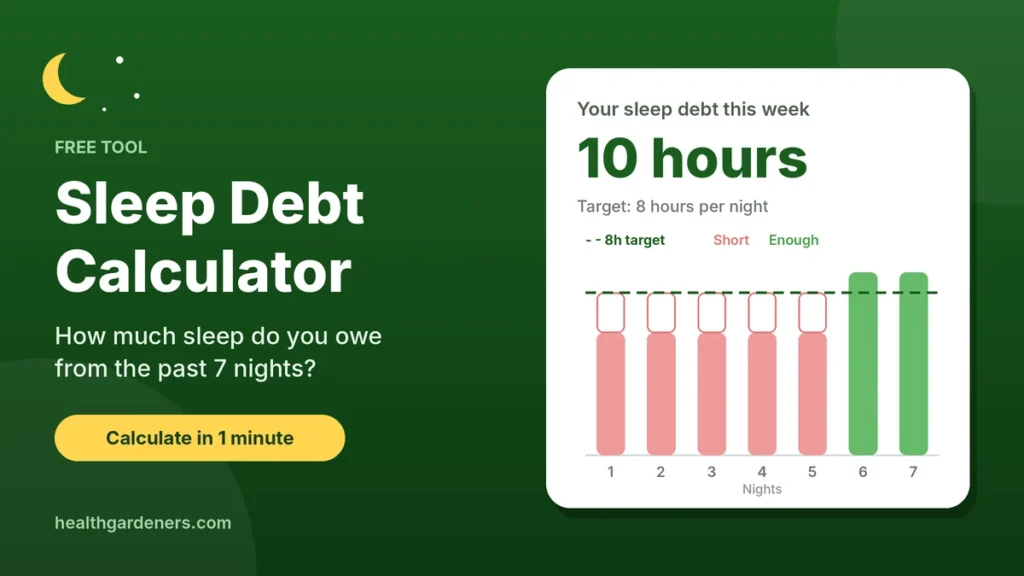
Short answer: A sleep debt calculator shows how much sleep you are short by over the past week. It compares the sleep you need each night with the sleep you actually got, and adds up the difference. Enter your hours below to see your total sleep debt and a simple plan to pay it back.
Free Sleep Debt Calculator
Enter how many hours you need each night, then how many hours you actually slept on each of the last 7 nights. Use decimals for part hours (for example, 6.5 for six and a half hours).
Sleep Debt Calculator
How to Calculate Sleep Debt
Sleep debt, also called a sleep deficit, is the gap between the sleep your body needs and the sleep you actually get. The National Institute for Occupational Safety and Health (NIOSH), part of the CDC, explains that it builds up day by day when you do not get enough sleep over a series of days.
The calculator above uses this simple formula for each night:
Sleep debt for one night = sleep you need − sleep you got
It then adds up the shortfall from every night. Nights when you sleep more than your target do not count as extra credit, because one long night does not cancel out several short ones.
Example
NIOSH gives this example: a person who needs 8 hours of sleep but gets only 6 hours builds up 2 hours of sleep debt that day. If that happens 5 days in a row, the debt adds up to 10 hours.
How Much Sleep Do You Need?
To use a sleep debt calculator, you first need a target. The CDC recommends:
| Age | Recommended sleep |
|---|---|
| 18 to 60 years | 7 or more hours |
| 61 to 64 years | 7 to 9 hours |
| 65 years and older | 7 to 8 hours |
The National Institute of Neurological Disorders and Stroke (NINDS) says most adults need 7 to 9 hours a night, but there is no single amount that works for everyone. A good personal target is the amount that lets you wake up feeling rested. NIOSH gives the same advice: regularly get the sleep you need to feel rested when you wake up.
What Your Result Means
Your result is the number of hours you are short compared with your own target. A small number after one busy week is common. A large number that keeps showing up week after week means you are regularly not getting the sleep you need. Sleep debt that builds up over weeks or months is often called chronic sleep debt.
NIOSH notes that as sleep debt builds, brain and body functioning get worse. For a full explanation of how lost sleep affects your energy, read our guide on sleep debt and how lost sleep adds up.
Keep in mind that the calculator only counts hours. You can sleep enough hours and still feel tired if your sleep is broken. If that sounds like you, see why you can still be tired after 8 hours of sleep.
How to Pay Back Sleep Debt
The good news is that you do not need to pay back every lost hour one for one. NIOSH explains that you sleep more deeply when you are sleep deprived, so you do not have to repay the debt hour for hour. These steps can help:
1. Add sleep slowly
The Sleep Foundation suggests increasing your sleep time slowly, by 15 to 30 minutes at a time. Going to bed a little earlier each night is easier to stick with than one big change.
2. Keep your wake-up time steady
The National Heart, Lung, and Blood Institute (NHLBI) advises keeping the same sleep schedule on weeknights and weekends, with a difference of no more than about an hour. Staying up late and sleeping in can disrupt your body clock. Learn more about how your circadian rhythm works.
3. Do not rely on weekend lie-ins
NINDS notes that, depending on how sleep-deprived you are, sleeping longer on weekends may not be enough to replace the sleep you missed. The Sleep Foundation also says it is unclear whether sleeping in actually makes up for sleep debt.
4. Give it time
NIOSH says that if you have not had enough sleep for many days, it might take several nights of good-quality sleep to recover.
5. Protect your sleep quality
Extra hours help most when your sleep is not broken up. Keep your bedroom cool, dark, and quiet, cut off caffeine early, and wind down before bed. Our guides on how to improve sleep quality naturally and a 60-minute night routine can help.
Limits of This Calculator
- It is an estimate. Your result is only as accurate as the hours you enter.
- Time in bed is not time asleep. Count the hours you were actually asleep, not the hours you spent in bed.
- It does not measure sleep quality. Broken sleep can leave you tired even with no sleep debt.
- It cannot diagnose a sleep problem. Only a healthcare professional can do that.
When to See a Doctor
NINDS advises seeing a doctor if you have problems sleeping or feel unusually tired during the day, and notes that most sleep disorders can be treated effectively. Talk to a healthcare provider if:
- You often cannot get enough sleep, even when you have the time
- You feel very sleepy during the day, even after paying back your sleep debt
- Someone tells you that you snore loudly or gasp for air during sleep. The NHLBI says this can be a sign of sleep apnea.
Frequently Asked Questions
How do you calculate sleep debt?
For each night, subtract the hours you slept from the hours you need. Then add up the shortfalls for the week. For example, if you need 8 hours and sleep 6 hours for 5 nights, your sleep debt is 10 hours.
How much sleep debt is too much?
There is no official cutoff. Any regular shortfall means you are not getting the sleep you need. If your sleep debt keeps building week after week, or you feel very tired during the day, change your sleep habits and talk to a doctor if it does not improve.
Can you pay off sleep debt?
Yes, short-term sleep debt can be paid back by getting more sleep. NIOSH says you do not need to repay it hour for hour, because you sleep more deeply when you are sleep deprived. After many short nights, it may take several nights of good sleep to recover.
How long does it take to recover from sleep debt?
It depends on how much sleep you lost and for how long. NIOSH says recovery from many days of short sleep may take several nights. The Sleep Foundation cites research suggesting it can take up to four days to recover from one hour of lost sleep.
Does sleeping in on weekends fix sleep debt?
Not fully. NINDS says sleeping longer on weekends may not be enough to replace the sleep you missed. Sleeping in can also disrupt your body clock, so it is better to add a little sleep each night.
What is chronic sleep debt?
Chronic sleep debt is sleep debt that builds up over weeks or months because you regularly sleep less than you need. It takes longer to recover from than a few short nights.
Is this sleep debt calculator accurate?
It is accurate for the numbers you enter, but it is only an estimate. It counts hours, not sleep quality, and it cannot diagnose a sleep problem. For the best result, enter the hours you were actually asleep.
The Bottom Line
A sleep debt calculator is a quick way to see how much sleep you owe. Set a realistic target, enter your last 7 nights, and pay back any debt slowly by adding 15 to 30 minutes of sleep at a time. Keep your wake-up time steady, and do not rely on one long lie-in. If you still feel tired, learn how to get more deep sleep, or talk to a doctor.
Sources
- National Institute for Occupational Safety and Health (CDC). Sleep Debt.
- Centers for Disease Control and Prevention. About Sleep.
- National Institute of Neurological Disorders and Stroke. Brain Basics: Understanding Sleep.
- National Heart, Lung, and Blood Institute. Healthy Sleep Habits.
- Sleep Foundation. Sleep Debt: The Hidden Cost of Insufficient Rest.
- National Heart, Lung, and Blood Institute. What Is Sleep Apnea?
This calculator and article are for general information only and are not medical advice. They cannot diagnose any condition. Always talk to a qualified healthcare provider about your health. Read our full Disclaimer.

The Health Gardeners Team researches and writes practical wellness content on sleep, nutrition, energy, and daily habits. Our articles are based on published research and guidance from reputable health organizations, and we review and update them regularly. We are not medical professionals, and our content is for general information only. It is not a substitute for advice from a qualified healthcare provider. Learn more about us.