Short answer: For most adults, the best nap length is 10 to 20 minutes. A short nap like this can make you more alert without leaving you groggy. Use the nap calculator below to see what time to set your alarm, or start the nap timer and let it wake you up.
Free Nap Calculator and Nap Timer
Choose when you will lie down and what kind of nap you want. The calculator adds time to fall asleep and tells you when to set your alarm. To nap right now, press Start nap timer and keep this page open.
Nap Calculator
After you wake up, give yourself 15 to 30 minutes to feel fully alert before driving or doing anything that needs quick reactions.
Keep this page open and your volume on. Some phones pause web pages when the screen locks, so set a phone alarm as a backup for longer naps.
How to Use the Nap Calculator
- Set the time you will lie down. Press Now if you are about to nap.
- Enter how long it takes you to fall asleep. The default is 10 minutes. Lower it if you fall asleep quickly, or raise it if you usually lie awake for a while.
- Choose your nap length. For most people, 20 minutes is the best choice.
- Press Calculate alarm time to see when to set your alarm, or press Start nap timer to have this page wake you up.
Before a long nap, press Test sound to check your volume. Keep this page open while the timer runs. Some phones pause web pages when the screen locks, so a phone alarm is a good backup.
Best Nap Length: Which Nap Is Right for You?
The National Institute for Occupational Safety and Health (NIOSH), part of the CDC, explains that both short naps (15 to 30 minutes) and longer naps can increase alertness. The difference is how you feel when you wake up.
| Nap length | What to expect | Best for |
|---|---|---|
| 10 minutes | Stays in light sleep, so grogginess on waking is usually small | A quick reset when you are short on time |
| 20 minutes | Short enough to avoid deep sleep for most people. NIOSH recommends a nap of under 20 minutes for day workers, and the NHLBI advises adults to nap no more than 20 minutes | Most people, most days |
| 30 minutes | Mayo Clinic calls 20 to 30 minutes ideal. You may feel slightly groggier than after 20 minutes | When 20 minutes does not feel like enough |
| About 60 minutes | Sleep reaches its deepest stage in about 1 hour, so waking here can leave you feeling much worse for a while | Best avoided |
| About 90 minutes | NIOSH notes grogginess may be less than after about an hour and may pass within 15 to 30 minutes | Very tired days, when you will not need to sleep soon after |
NIOSH also notes that if you are very sleep deprived when you start your nap, your brain may reach deep sleep more quickly. On those days, a shorter nap is safer.
Why Do Naps Make Me More Tired?
If you wake up from a nap feeling worse than before, you are likely feeling sleep inertia. This is a short period of grogginess and lower performance after waking. Mayo Clinic says it often goes away within about 35 minutes.
The length of your nap matters. NIOSH explains that sleep gets deeper the longer you sleep, reaching the deepest level, slow-wave sleep, in about 1 hour. If you wake up during deep sleep, you are more likely to feel groggy. That is why a 45- to 60-minute nap can leave you feeling worse than a 20-minute one.
To learn more about the stages of sleep, read our guide on deep sleep and how to get more of it.
Best Time to Take a Nap
Early afternoon is usually the best time to nap. Mayo Clinic notes that napping after 3 p.m. can make it harder to sleep well at night. The National Heart, Lung, and Blood Institute (NHLBI) also advises that if you have trouble falling asleep at night, you should limit naps or take them earlier in the afternoon.
The calculator above shows a reminder if your nap would end after 3 PM. Your body clock plays a role too. Learn more about how your circadian rhythm affects sleep and energy.
How to Take a Power Nap Without Oversleeping
- Always set an alarm. NIOSH suggests setting an alarm for 15 to 30 minutes. The nap timer above can do this for you.
- Nap somewhere restful. Mayo Clinic recommends a quiet, dark place with a comfortable temperature and few distractions. See our guide to the best bedroom environment for sleep.
- Put your phone down. Scrolling while you try to fall asleep makes the nap shorter and less restful. See how screen time affects sleep.
- Give yourself time to wake up. Mayo Clinic advises allowing time to fully wake up before doing tasks that need quick, sharp responses.
- Feeling sleepy while driving? The NHLBI advises pulling off the road to a safe place and taking a 15- to 20-minute nap.
Can a Nap Make Up for Lost Sleep?
A nap can help you feel more alert for a while. NIOSH notes that a brief nap can increase alertness for a couple of hours, and does not disrupt your sleep that night.
If you find you need a nap every day, though, it may be a sign you are not getting enough sleep at night. Use our free sleep debt calculator to see how much sleep you owe from the past week. If you sleep enough hours and still feel tired, read why you can still be tired after 8 hours of sleep.
When to See a Doctor
Mayo Clinic recommends talking with a healthcare professional if you feel the need to nap more than usual, especially if you still feel sleepy or tired after waking up in the morning.
Frequently Asked Questions
What is the best nap length?
For most adults, 10 to 20 minutes. NIOSH recommends a brief nap of under 20 minutes for people who work during the day, and Mayo Clinic says a 20- to 30-minute nap is ideal.
How does a nap calculator work?
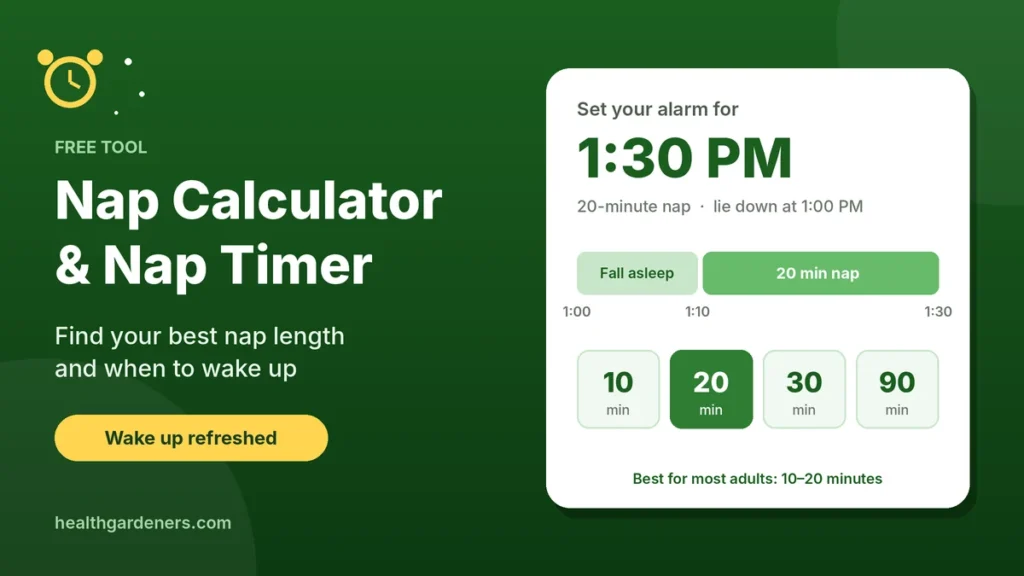
It adds the time it takes you to fall asleep to the nap length you choose, then shows the time to set your alarm. For example, if you lie down at 1:00 PM, take 10 minutes to fall asleep, and want a 20-minute nap, set your alarm for 1:30 PM.
Is a 20-minute nap enough?
For most people, yes. A 20-minute nap is long enough to feel more alert and short enough to avoid most of the grogginess that comes from waking up in deep sleep.
Is a 45-minute nap good?
It can leave you feeling groggy. NIOSH explains that sleep gets deeper the longer you sleep and reaches its deepest level in about 1 hour, so waking at 45 minutes may pull you out of deeper sleep. A 20-minute nap or a longer nap of about 90 minutes is usually easier to wake from.
Why do I feel worse after a nap?
This is usually sleep inertia, the grogginess you feel after waking from deeper sleep. It often goes away within about 35 minutes. Keeping naps to 20 minutes makes it less likely.
What time should I stop napping?
Try to finish your nap by mid-afternoon. Mayo Clinic notes that napping after 3 p.m. can make it harder to sleep well at night.
Does the nap timer work if my screen turns off?
Keep this page open and your volume on. The timer asks your device to keep the screen awake where supported, but some phones pause web pages when the screen locks. For longer naps, set a phone alarm as a backup.
The Bottom Line
The best nap for most people is 10 to 20 minutes, taken in the early afternoon. Use the nap calculator to find your alarm time, or start the nap timer and let it wake you. Avoid naps of about an hour, which can leave you groggy, and if you need naps every day, check your nighttime sleep. For more ways to rest better, see our tips to improve sleep quality naturally.
Sources
- National Institute for Occupational Safety and Health (CDC). Napping, an Important Fatigue Countermeasure: Nap Duration.
- National Institute for Occupational Safety and Health (CDC). Napping, an Important Fatigue Countermeasure.
- Mayo Clinic. Napping: Do’s and don’ts for healthy adults.
- National Heart, Lung, and Blood Institute. Healthy Sleep Habits.
- National Heart, Lung, and Blood Institute. In Brief: Your Guide to Healthy Sleep.
This calculator and article are for general information only and are not medical advice. They cannot diagnose any condition. Always talk to a qualified healthcare provider about your health. Read our full Disclaimer.

The Health Gardeners Team researches and writes practical wellness content on sleep, nutrition, energy, and daily habits. Our articles are based on published research and guidance from reputable health organizations, and we review and update them regularly. We are not medical professionals, and our content is for general information only. It is not a substitute for advice from a qualified healthcare provider. Learn more about us.