Short answer: Sleep efficiency is the share of your time in bed that you actually spend asleep. To calculate it, divide your total sleep time by your time in bed and multiply by 100. A sleep efficiency of 85% or higher is linked with good sleep quality. Use the free calculator below to find your score in a few seconds.
Free Sleep Efficiency Calculator
Enter what happened last night. The calculator works out your time in bed, your actual sleep time, and your sleep efficiency score.
Sleep Efficiency Calculator
One night can be unusual. For a clearer picture, check your score on several nights and look at the average.
How to Use the Sleep Efficiency Calculator
- Enter the time you got into bed to sleep last night.
- Enter the time you got out of bed for the day. The calculator handles times that cross midnight.
- Enter how many minutes it took you to fall asleep. A rough guess is fine.
- Enter how many minutes you were awake during the night. Add up all the times you woke up.
- Enter any minutes you lay awake in bed in the morning before getting up. Leave it at 0 if you got up right away.
- Press Calculate sleep efficiency to see your score, your time in bed, and your actual sleep time.
If you use a sleep tracker, you can enter the times and awake minutes it shows. If not, your best estimate works well enough to spot a pattern.
What Is Sleep Efficiency?
Sleep efficiency is a simple measure of how well you use your time in bed. The National Sleep Foundation defines it as the ratio of time asleep to time lying in bed.
A high score means you fall asleep fairly quickly and stay asleep. A low score means you spend a lot of your time in bed awake, either trying to fall asleep, waking up during the night, or lying in bed after you wake up.
Sleep efficiency is one of the main signs of sleep quality, along with how long it takes to fall asleep and how often you wake up. It is different from sleep quantity, which is simply how many hours you sleep. You need both. To check whether you are getting enough hours, use our sleep debt calculator.
How to Calculate Sleep Efficiency
The sleep efficiency formula is:
Sleep efficiency (%) = (total sleep time / time in bed) x 100
Here is how to work it out by hand:
- Find your time in bed. Count the minutes from when you got into bed to when you got out of bed.
- Find your total sleep time. Take your time in bed and subtract the minutes it took to fall asleep, the minutes you were awake during the night, and any minutes you lay awake before getting up.
- Divide and multiply. Divide your total sleep time by your time in bed, then multiply by 100.
Sleep Efficiency Example
| Step | Example |
|---|---|
| In bed | 11:00 PM |
| Out of bed | 7:00 AM |
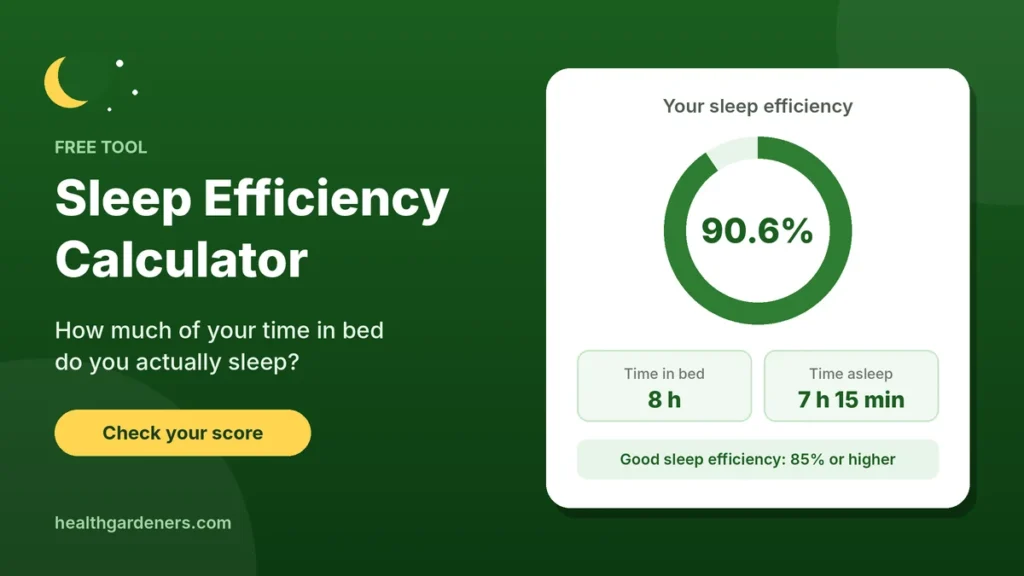
| Time in bed | 8 hours (480 minutes) |
| Time to fall asleep | 20 minutes |
| Awake during the night | 25 minutes |
| Total sleep time | 480 – 20 – 25 = 435 minutes (7 hours 15 minutes) |
| Sleep efficiency | 435 / 480 x 100 = 90.6% |
Here is a simpler example from Northwell Health: if you are in bed for 8 hours but asleep for only 6, your sleep efficiency is 75%.
What Is a Good Sleep Efficiency Score?
A sleep efficiency of 85% or higher is generally considered good. In its guidance on good-quality sleep, the National Sleep Foundation lists spending at least 85% of your time in bed asleep as a key sign. Northwell Health says a good sleep efficiency score should be around 85% to 90%.
The calculator above uses these labels:
| Sleep efficiency | What it means |
|---|---|
| 85% or higher | Good. In the range linked with good sleep quality |
| 75% to 84.9% | A little below the good range. You spent extra time awake in bed |
| Below 75% | Well below the good range. A large part of your time in bed was spent awake |
The National Sleep Foundation also looks at a few other signs of good sleep quality. These help explain why your score may be high or low:
| Sign of good sleep quality | Adults 18 to 64 | Adults 65 and older |
|---|---|---|
| Time to fall asleep | 30 minutes or less | 30 minutes or less |
| Times you wake up during the night | 1 or fewer | 2 or fewer |
| Time awake after first falling asleep | 20 minutes or less | 30 minutes or less |
| Time asleep while in bed | Mostly asleep (for example, 7 out of 8 hours) | Mostly asleep (for example, 7 out of 8 hours) |
Good Sleep Efficiency Is Not the Same as Enough Sleep
A high score does not mean you slept long enough. If you are in bed for only 6 hours and sleep 5 hours and 45 minutes, your efficiency is about 96%, but you still got less sleep than you need. The CDC says adults aged 18 to 60 need 7 or more hours of sleep a night. Always look at your total sleep time too. If you sleep enough hours and still feel tired, read why you can still feel tired after sleeping enough.
Why Is My Sleep Efficiency Low?
A low score means you spent a lot of time awake in bed. Common everyday reasons include:
- Taking a long time to fall asleep. Going to bed before you feel sleepy, or using your phone in bed, can keep you awake longer.
- Waking up during the night. Noise, light, a warm room, or needing the bathroom can break up your sleep.
- Staying in bed after waking up. Lying in bed for a long time in the morning lowers your score, even if you slept well.
- An irregular sleep schedule. Changing your bedtime and wake time from day to day can make it harder to fall asleep. Learn more about how your body clock works.
- Caffeine or alcohol too late in the day. The NHLBI notes that the effects of caffeine can last up to 8 hours.
- Long or late naps. A long nap can make it harder to fall asleep at night.
Low sleep efficiency on most nights can also be linked to sleep problems such as insomnia. If that sounds like you, see the section on when to talk to a doctor below.
How to Improve Sleep Efficiency
These simple habits come from trusted health sources and can help you spend more of your time in bed asleep:
- Keep the same sleep schedule every day. The CDC and NHLBI both recommend going to bed and getting up at the same time every day, including weekends.
- Get out of bed if you cannot sleep. Northwell Health suggests that if you have been awake for more than about 15 minutes, get up and do something calming until you feel drowsy.
- Stop caffeine in the afternoon. The CDC advises avoiding caffeine in the afternoon or evening.
- Avoid large meals and alcohol before bed. The CDC lists both as things to avoid before bedtime.
- Turn off screens before bed. The CDC suggests turning off electronic devices at least 30 minutes before bedtime. See how screen time affects sleep.
- Make your bedroom quiet, cool, and dark. This is a tip from the NHLBI. Our guide to the best bedroom environment for sleep covers light, temperature, and noise.
- Keep naps short. The NHLBI says adults should nap for no more than 20 minutes. Our nap calculator and nap timer can help you wake up on time.
- Follow a relaxing wind-down routine. Try our 60-minute night routine for better sleep.
Sleep specialists also use sleep efficiency when treating insomnia, sometimes by changing how much time a person spends in bed. That kind of program should be guided by a qualified professional, not done on your own.
For more ideas, read our 12 tips to improve sleep quality naturally.
Sleep Efficiency vs Sleep Tracker Scores
Many smartwatches, rings, and apps show a sleep efficiency number or an overall sleep score. These devices estimate your sleep from things like movement and heart rate, so their numbers may not match exactly what happened. Each brand also calculates its overall sleep score in its own way, so a sleep score is not always the same thing as sleep efficiency.
Trackers can still be useful for spotting patterns. However, the American Academy of Sleep Medicine (AASM) states that consumer sleep technology cannot be used to diagnose or treat sleep disorders. It says these devices may help improve conversations between patients and their clinicians.
When to Talk to a Doctor
The CDC advises talking to your healthcare provider if you regularly have problems sleeping. Your provider can run tests, including sleep studies, to find out if you have a sleep disorder.
It is a good idea to get help if your sleep efficiency is low on most nights, if it takes you a long time to fall asleep most nights, or if you feel very sleepy during the day even when you spend enough time in bed.
Frequently Asked Questions
What is sleep efficiency?
Sleep efficiency is the percentage of your time in bed that you spend asleep. For example, if you are in bed for 8 hours and asleep for 7, your sleep efficiency is 87.5%.
What is a good sleep efficiency?
85% or higher. The National Sleep Foundation links spending at least 85% of your time in bed asleep with good sleep quality, and Northwell Health says a good score is around 85% to 90%.
How do you calculate sleep efficiency percentage?
Divide your total sleep time by your time in bed, then multiply by 100. For example, 435 minutes of sleep during 480 minutes in bed gives 435 / 480 x 100 = 90.6%.
Is 80% sleep efficiency good?
It is a little below the 85% level linked with good sleep quality. It means you spent about 1 hour and 36 minutes of an 8-hour night awake in bed. The tips above can help you raise it.
Does the time it takes to fall asleep count?
Yes. Time spent trying to fall asleep counts as time in bed but not as sleep time, so it lowers your score. The National Sleep Foundation lists falling asleep in 30 minutes or less as a sign of good sleep quality.
Are the signs of good sleep different for older adults?
A little. The National Sleep Foundation uses slightly different signs of good sleep for adults 65 and older, allowing up to 2 wake-ups a night and up to 30 minutes awake after first falling asleep. The 85% sleep efficiency level is the same.
Can I use my sleep tracker data in this calculator?
Yes. Enter the bedtime, wake time, and awake minutes your tracker shows. Keep in mind that trackers estimate your sleep, so the result is a helpful guide, not an exact measurement.
The Bottom Line
Sleep efficiency shows how much of your time in bed you actually spend asleep. Divide your total sleep time by your time in bed and multiply by 100, or use the free calculator above. A score of 85% or higher is linked with good sleep quality. If your score is low, keep a regular sleep schedule, get out of bed when you cannot sleep, and limit caffeine, alcohol, and screens before bed. Also make sure you sleep enough hours, and talk with a healthcare provider if you regularly have trouble sleeping.
Sources
- National Sleep Foundation. What Is Sleep Quality?
- ScienceDaily (National Sleep Foundation). What is good quality sleep? National Sleep Foundation provides guidance.
- Northwell Health. Sleep efficiency tips.
- Centers for Disease Control and Prevention. About Sleep.
- National Heart, Lung, and Blood Institute. Healthy Sleep Habits.
- American Academy of Sleep Medicine. Consumer Sleep Technology: AASM Position Statement.
This calculator and article are for general information only and are not medical advice. They cannot diagnose any condition. Always talk to a qualified healthcare provider about your health. Read our full Disclaimer.

The Health Gardeners Team researches and writes practical wellness content on sleep, nutrition, energy, and daily habits. Our articles are based on published research and guidance from reputable health organizations, and we review and update them regularly. We are not medical professionals, and our content is for general information only. It is not a substitute for advice from a qualified healthcare provider. Learn more about us.